A luxury car can have a magnificent engine and chassis and still spend a surprising amount of time annoying you in a parking lot.
This is the final chapter of our F10 series: the frustrating little failures, the smart maintenance choices and our answer to whether the 530d is worth owning.
Headlights: Apparently Seeing the Road Was Optional
The F10 is a spectacular highway cruiser. There's just one small requirement when driving at night: you need to see where you're going.
And apparently, BMW didn't consider this quite as important as we did.
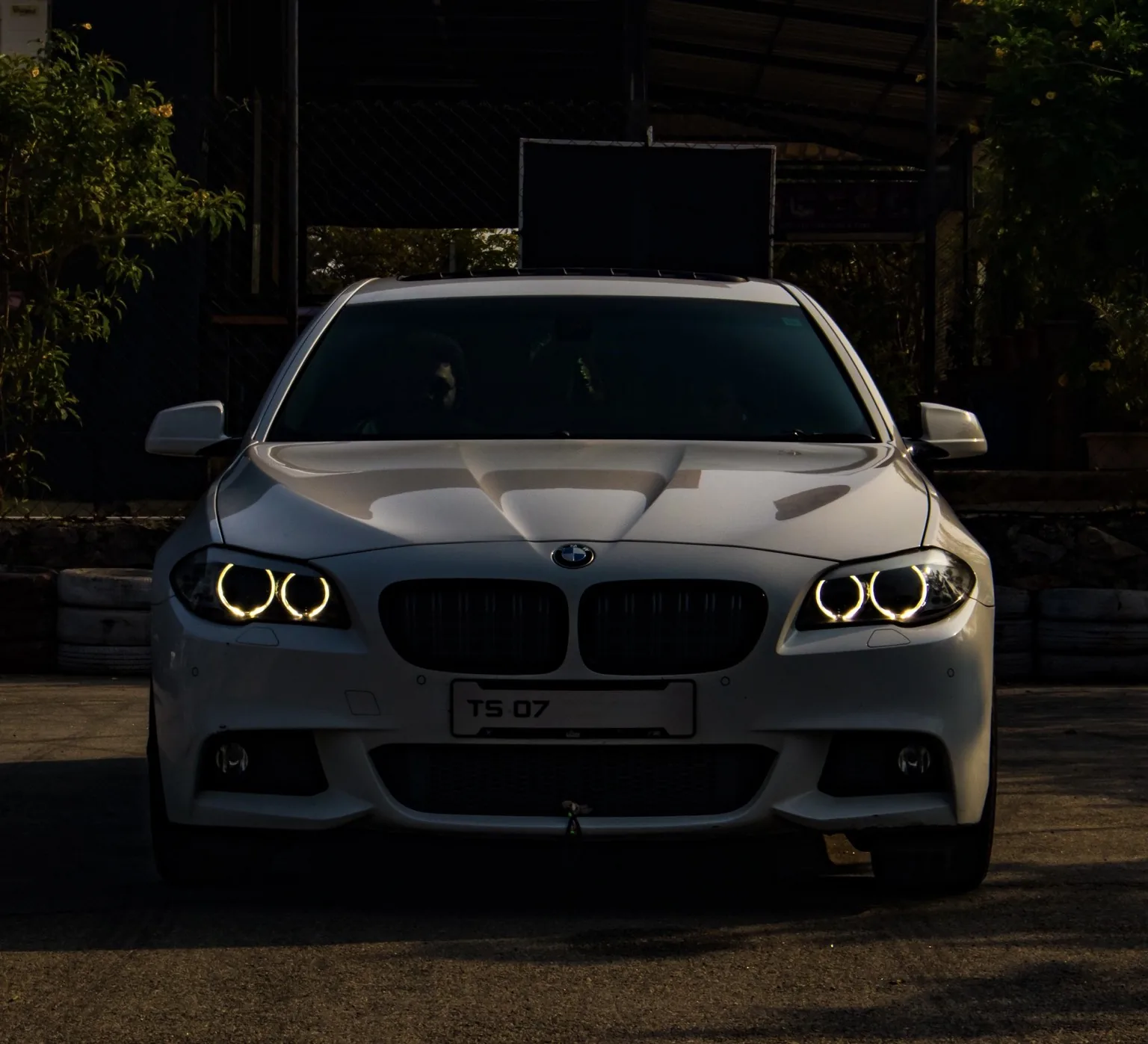
Earlier cars came with Bi-Xenon headlights. Later configurations offered Adaptive LED technology. You'd expect the latter to be a dramatic improvement.
In our experience, neither system was particularly impressive, especially as the assemblies aged.
Before throwing money at replacement lights, inspect the headlamp alignment, projector condition, xenon bulbs, reflectors, lenses and adaptive electronics.
But when the original headlights are healthy and still don't deliver the illumination you want, properly selected auxiliary driving lights can be worth considering.
A discreet auxiliary light bar integrated into the grille can improve illumination for suitable off-road or controlled-use applications. It must, however, comply with applicable regulations, be properly aimed and never dazzle other road users.
Because upgrading your headlights shouldn't involve making everyone travelling in the opposite direction temporarily blind.
The Wipers Aren't Much Better
And then there's Hyderabad during the monsoon. One moment it's raining. The next, someone appears to have emptied an entire reservoir onto the road.
Unfortunately, the F10's wipers never felt particularly enthusiastic during extremely heavy rainfall. Even at their highest setting, we found the sweep speed rather disappointing.
Fresh blades, a clean windscreen and a healthy mechanism are essential, but they don't necessarily address the limitations we experienced.
A frustrating little shortcoming in an otherwise extraordinary long-distance cruiser.
Door Locks: Permission to Enter Denied
You'd think the automotive industry had figured out door locks by 2010. Apparently not.
The F10 has an irritating tendency to develop failures in its electronic door-latch mechanisms. And when they fail, they can be spectacularly inconvenient.
If the door is locked, it might refuse to unlock. If it's unlocked, it might refuse to lock. Sometimes one particular door simply decides it no longer wants to participate in the central-locking system.
Imagine arriving somewhere, pressing the lock button and discovering that one door has decided to remain permanently accessible to the general public.
Welcome to BMW ownership.
If the latch actuator itself has failed, replacement is generally the sensible solution. But before condemning the assembly, check its wiring, electrical commands and related control-system faults.
The Key Receiver: The Car Has Forgotten Who You Are
As if failing door locks weren't enough, the remote-key reception system can develop problems too.
Faults involving the key, antennas, receiver electronics or Comfort Access system can result in intermittent locking and unlocking failures.
You press the remote. Nothing. Press it again. Still nothing.
Now imagine you're already late for an important meeting. You finally reach your destination, get out of the car and discover it refuses to lock.
You can't confidently leave it unlocked. And you certainly don't have time to start diagnosing BMW electronics in the parking lot.
You're now late because your luxury German sedan has forgotten how doors work. How incredibly BMW.
Check the key battery and spare key first, then diagnose the receiver and associated control electronics before replacing components. And learn how the mechanical emergency key works before you actually need it.
Interior Door Handles: Death by Chocolate
Now we come to one of BMW's more creative interior design decisions: the soft-touch interior grab handles.
When new, they looked and felt premium. Then the years passed. And the coating began deteriorating.
Depending on the interior trim colour, you could have Death by Chocolate, Red Velvet or Vanilla.
Unfortunately, BMW forgot one very important detail: your interior door handle isn't supposed to melt in your hands like ice cream.
The coating becomes sticky, deteriorates and eventually starts leaving residue on your fingers. Wonderful.
For a vehicle that once cost luxury-car money, it's embarrassing.
Fortunately, replacement handle components are available, including aftermarket versions that avoid the original deteriorating rubberised finish. Replace them with good-quality components and move on.
Because closing your car door without getting sticky plastic on your hands really shouldn't count as a luxury feature.
The Rear-View Mirror: An Unexpected Departure
Just when you think the interior has run out of ways to entertain you, there's another surprise: the rear-view mirror mounting arrangement and the rain/light sensor assembly.
Ageing adhesive, deteriorated optical coupling materials or previous improper windscreen repairs can create problems around these components. In some cases, the mounting hardware can loosen or separate unexpectedly.
One moment everything is normal. The next, something near your rear-view mirror is hanging where it shouldn't be. Fantastic.
The rain sensor can also stop functioning correctly if its optical connection to the windshield is compromised.
The correct repair depends on whether the mechanical mounting bracket or the optical coupling pad has failed. Don't simply attack everything with whatever glue happens to be lying around.
BMW might have made this unnecessarily entertaining, but that doesn't mean the repair needs to be equally creative.
Audio Systems: BMW, Please Take Notes From Volvo
BMW knows how to engineer spectacular engines. Unfortunately, the same enthusiasm doesn't always extend to factory audio.
The early F10s we encountered had BMW's Hi-Fi audio system. And it was okay. Not terrible. Not spectacular. Just okay.
Which is rather disappointing in a premium executive sedan.
Later Indian-market configurations offered Harman Kardon, which was a welcome improvement. Better output, a more convincing presentation and a generally more enjoyable listening experience.
But exceptional? Not really.
For a car this expensive, you'd expect something genuinely impressive. BMW could take a few lessons from Audi and Volvo here.
And this becomes particularly interesting when you look at newer models equipped with Bowers & Wilkins systems. BMW offers Bowers & Wilkins. Volvo offers Bowers & Wilkins.
Yet, to our ears, the Volvo implementation can sound dramatically better.
Why? Because premium audio isn't simply about buying expensive speakers and sticking a prestigious badge on the grille.
Speaker placement matters. Cabin acoustics matter. Amplification matters. Digital signal processing matters. The final system integration matters.
Two manufacturers can use the same audio brand and produce completely different listening experiences.
And BMW's results can be frustrating considering how brilliantly the company engineers the rest of the driving experience.
The Code6 Approach: Maintain Smart, Not Expensive
One of the biggest mistakes owners make with ageing German luxury cars is assuming that every replacement component needs to come in a BMW-branded box.
It doesn't. You need quality components. You need the correct specifications. And you need someone who understands how the vehicle is engineered.
For suspension arms, we'd happily consider genuine Lemförder. For standard shock absorbers, Sachs or Bilstein B4. For more controlled damping, Bilstein B6.
For brake rotors, Zimmermann is an excellent option. For the transmission, use genuine ZF or BMW-approved components and the exact fluid specification applicable to the gearbox.
And for engine oil, don't compromise on the correct BMW LL-04 approval where specified.
Cheap parts are not necessarily good value. But neither is paying three times as much simply because the cardboard box has a BMW logo on it.
These are conservative workshop recommendations based on our experience, not a replacement for BMW's model-specific service instructions.
Code6’s Conservative Maintenance Checklist
| Maintenance area | Code6 recommendation |
|---|---|
| Engine oil and filter | Every 5,000 km or sooner under demanding conditions |
| Engine oil specification | Appropriate BMW LL-04 approval |
| ZF 8HP oil and filter | Every 50,000 km |
| Suspension bushes and ball joints | Inspect regularly, particularly from 30,000 km |
| Shock absorbers | Assess damping performance, not just external leaks |
| Cooling system | Check heat exchangers, radiator, hoses, thermostat and temperatures |
| Braking system | Monitor disc thickness, pad condition, fluid and heat-related wear |
| Wheels and tyres | Inspect after severe pothole impacts |
| Timing-chain system | Investigate abnormal noise or diagnostic symptoms promptly |
| Fuel system | Use clean fuel; investigate contamination or rail-pressure faults |
These intervals are conservative Code6 workshop recommendations, not a replacement for BMW model-specific service instructions.
The Verdict: Would We Actually Recommend an F10 530d?
After everything we've discussed, you'd probably expect us to tell you to stay as far away from the F10 530d as humanly possible.
And honestly? If you want a car that requires nothing more than fuel, occasional servicing and absolutely no mechanical attention, this probably isn't the car for you.
Because the N57 can be expensive. The suspension components wear. The brakes can benefit from upgrading. The electronics develop irritating faults. The door handles melt. The headlights disappoint.
And the engine has enough potential failure points to keep a workshop busy for a very long time.
But then you drive one. And suddenly, everything makes sense.
The way that straight-six delivers torque. The way the ZF 8HP moves through its gears. The effortless high-speed cruising. The remarkable chassis balance. The way a nearly two-tonne luxury sedan somehow feels planted, neutral and unexpectedly entertaining.
And the sheer refinement of it all.
There's something deeply satisfying about an engine that produces this much performance without constantly reminding you how hard it's working.
The F10 530d is one of those rare cars that combines luxury, performance and long-distance capability in a way that still feels special years after production ended.
It's an ocean liner that somehow learned how to dance.
But owning one requires commitment. You need to maintain it properly. You need to understand its weaknesses. And you need to accept that sometimes, despite doing everything right, an expensive repair might still arrive uninvited.
Would we buy another one? For the right car, with the right maintenance history and a healthy engine? Absolutely.
Would we recommend buying the cheapest example on the market and hoping for the best? Not a chance.
Because the only thing more expensive than a well-maintained BMW 530d is a badly maintained BMW 530d.
And if there's one piece of advice we'd leave you with, it's this:
Change the oil. Maintain the gearbox. Keep the cooling system healthy. And don't ignore the little things.
Do that, and the F10 can reward you with one of the finest diesel grand-touring experiences of its generation.
Neglect it, and BMW will be delighted to sell you another engine. For approximately ₹18 lakh.
Welcome to BMW ownership.
- BMW
- 530d
- F10
- N57
- ZF 8HP