A large BMW that cruises beautifully at speed is only as good as the things connecting it to the road: tyres, wheels, bushes, dampers and brakes.
This is the practical Code6 guide to making an ageing F10 drive properly again, without replacing every part with an expensive logo or turning a grand tourer into a bone-shaker.
Brakes: BMW Gave It the Power, Then Forgot About Stopping
Now, for all that incredible high-speed stability, there's one area where we believe the factory car could have been better: the brakes.
Earlier F10 530d configurations used 348 × 30 mm ventilated front discs. They're adequate for normal use, but repeated demanding braking can expose their thermal limitations.
Later and higher-specification configurations received 348 × 36 mm front discs, providing increased material thickness and thermal capacity. The exact fitment depends on production date and braking package, rather than the LCI badge alone.
It's an improvement. But we'd go further.
The 374 × 36 mm Upgrade
One of our preferred OEM-based upgrade directions is the larger 374 × 36 mm braking setup associated with certain higher-performance BMW applications, including the 550i. Alpina B5 hardware is another interesting reference point.
More recently, suitably adapted four-piston BMW M Sport caliper arrangements, including G30-based configurations, have made this an even more interesting upgrade path.
The larger disc provides additional braking leverage and thermal capacity, while some fixed aluminium caliper designs offer potential weight advantages over heavier assemblies.
But don't assume a larger brake kit automatically reduces unsprung mass. Disc weight, caliper weight and the entire assembly must be considered.
And if money is no object? There's always the F10 M5 steel braking system. Enormous front rotors, six-piston calipers and serious stopping hardware.
Of course, any retrofit requires proper verification of wheel clearance, mounting compatibility, hydraulic balance and the associated components.
Stop Skimming Discs That Should Be Replaced
Here's something we take very seriously at Code6. Brake discs are safety-critical. They aren't components where we'd recommend trying to save a few thousand rupees at the expense of structural integrity.
Correctly performed resurfacing can be acceptable when the manufacturer permits it and the disc remains safely above its minimum thickness.
But a disc that's excessively worn, badly heat-damaged, cracked or below its allowable thickness needs replacement. Period.
And for a heavy, powerful F10 subjected to demanding use, we'd generally prefer quality new discs over unnecessarily machining worn ones.
Zimmermann makes excellent replacement rotor options. And depending on driving requirements, there's an extensive range of brake pads available.
The important thing is choosing the correct combination. Because having a 374 mm disc means very little if you've fitted pads that fade the moment they get properly hot.
How to Read the Caliper Casting
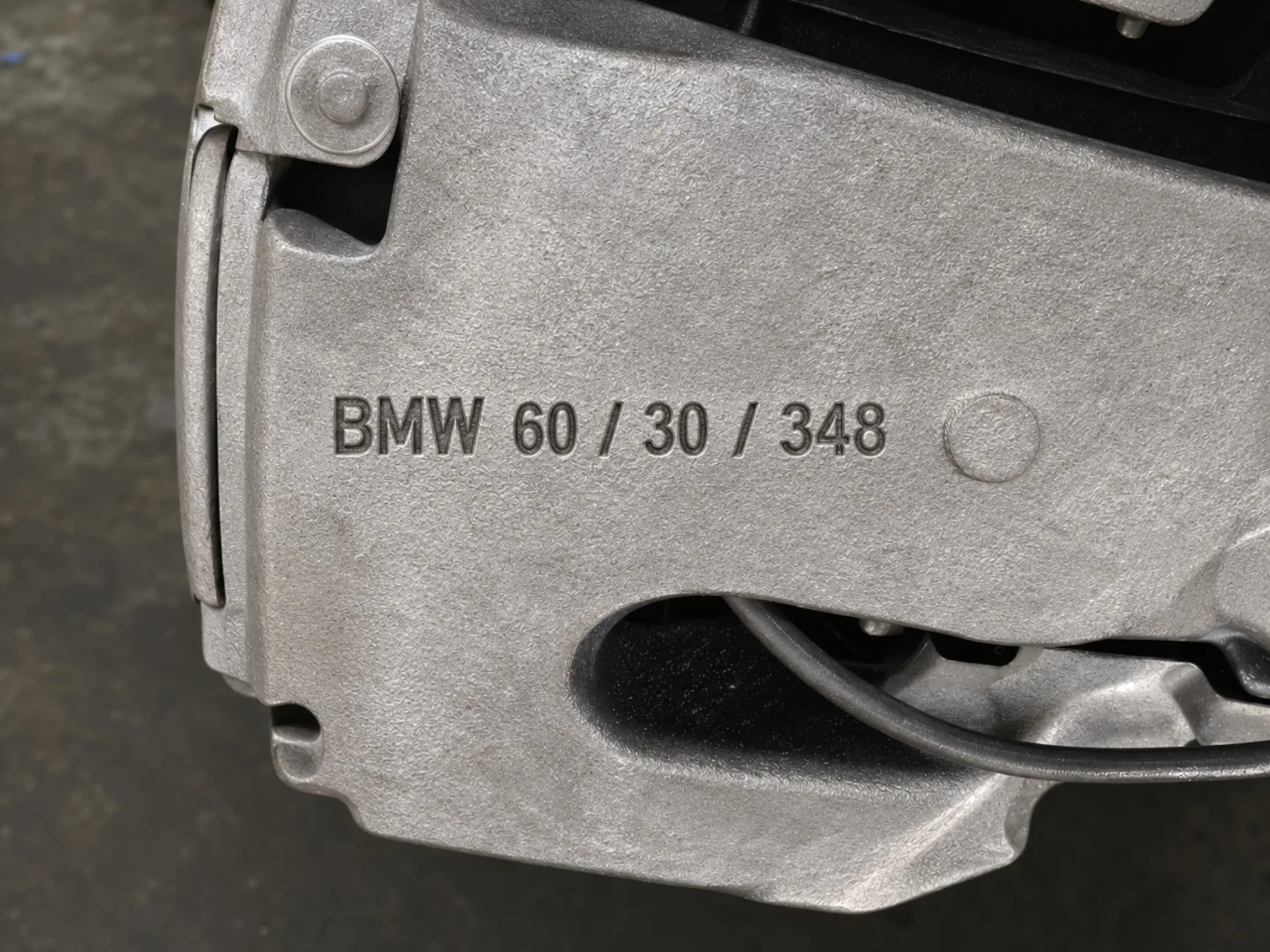
Here is a workshop trick that saves a lot of guessing. Our pre-LCI 530d front caliper is marked BMW 60 / 30 / 348. In this application, 60 denotes the nominal piston diameter, 30 the specified disc thickness and 348 the specified disc diameter, all in millimetres. That last pair means 348 x 30 mm front discs.
Do not order replacement brakes from the badge or model year alone. Check the original caliper marking, the VIN-specific parts catalogue and the actual hardware, especially on a car that may have been upgraded over its lifetime.
Suspension: Brilliant Engineering, Questionable Longevity
The F10 has an excellent chassis. Unfortunately, the components keeping that chassis in shape don't always last particularly long under Indian road conditions.
In our workshop experience, we begin paying close attention to suspension bushes at around 30,000 km. It's not an automatic replacement interval, but deterioration can begin surprisingly early.
Cracking, softening and separation of the rubber bushes can eventually lead to excessive suspension movement. The lower control-arm bushes are particularly worth watching.
The upper arms often seem to survive longer, although everything should be checked individually.
And when it comes to replacements, we don't see much point in paying enormous amounts for BMW-branded control arms when suitable genuine Lemförder components are available.
Lemförder is an established OE supplier and an excellent choice for restoring the original suspension behaviour.
The Steering Isn't Particularly Talkative
Unlike the hydraulically assisted steering used on the F10 M5, the regular rear-wheel-drive 530d uses electric power steering. And yes, there's a noticeable difference in feedback.
The steering is accurate enough, but it doesn't communicate quite as much through the wheel as we'd like. But the electric rack isn't entirely responsible.
Take a look at the front suspension bushes. They're enormous.
More importantly, their compliant rubber construction, geometry and permitted deflection are designed to isolate road vibration and improve refinement. Unfortunately, the same compliance can soften steering response.
Naturally, the aftermarket has a solution: solid bushes. And while reducing compliance can sharpen steering response, our advice for road use is straightforward: don't bother.
Unless you're building something specifically for track use, the increase in noise, vibration and harshness can completely undermine what makes the F10 so good.
Every pothole and expansion joint becomes a new opportunity for your spine to communicate with the chassis.
Fresh OE-style rubber bushes are a much better choice for a luxury grand tourer. Don't ruin an ocean liner trying to turn it into a go-kart.
Shock Absorbers: The Failure You Might Never Notice
Here's a particularly interesting observation from our workshop: shock absorbers can fail without leaking externally. And the F10 can remain surprisingly stable even with substantially deteriorated dampers.
One of the first F10s we inspected appeared to have perfectly acceptable shock absorbers from the outside. No visible leakage. No dramatic instability. Nothing particularly alarming.
It was only after removing them and assessing their operation that we discovered how badly the damping performance had deteriorated.
That's an important lesson. A dry shock absorber isn't necessarily a healthy shock absorber. And the absence of obvious bouncing doesn't automatically mean everything is working correctly.
What Shocks Would We Recommend?
Fortunately, there's a massive aftermarket for the F10.
- Sachs OE-equivalent: Excellent for restoring the original comfort-oriented character.
- Bilstein B4: Another sensible OE-style replacement that retains the refined factory feel.
- Bilstein B6: Our preferred option for enthusiasts willing to accept some additional low-speed firmness in exchange for improved body control.
The B6 can feel slightly stiffer over sharp imperfections at lower speeds. But at higher speeds and under more demanding conditions, the improved control can make the car feel considerably more settled.
For a grand tourer, that's an attractive compromise. Just remember that suspension configurations vary, particularly on cars originally equipped with electronic damping. Always match the replacement components to the vehicle.
One Upgrade That Just Feels Right: The M Sport Wheel
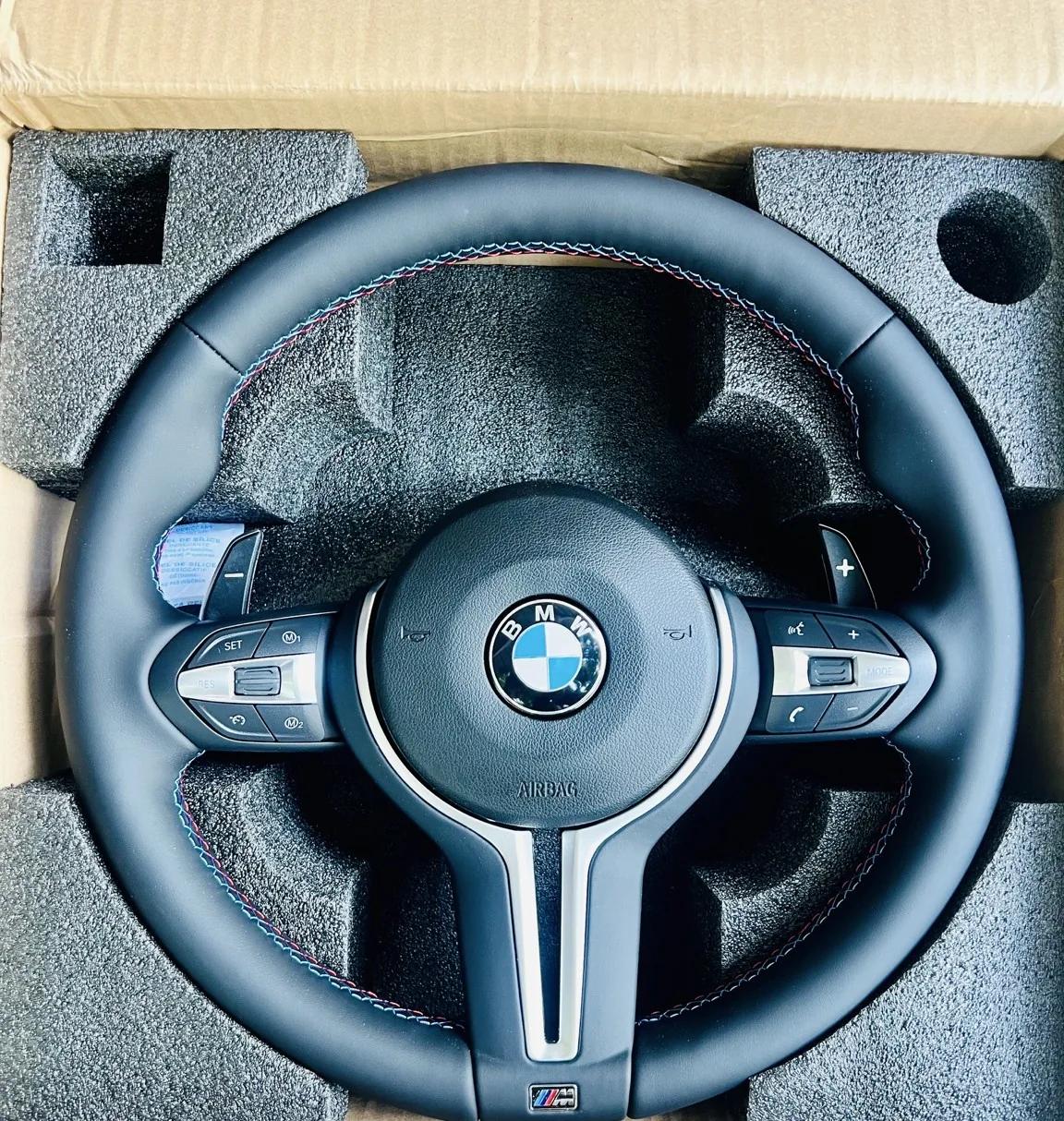
We have also performed an M Sport steering-wheel retrofit at Code6. The thicker-feeling rim, three-colour M stitching and paddle shifters transform the look and feel of the driver’s seat without changing what makes this such an excellent grand tourer.
No, it will not turn the regular electric steering rack into an M5 hydraulic system. But a better wheel in your hands is still a pleasant upgrade. Airbag compatibility, steering-wheel electronics, paddles and vehicle coding must all be confirmed for the specific car.
Wheels and Tyres: Hyderabad Potholes Would Like a Word
The F10 looks spectacular on its factory 18-inch staggered alloy wheels. But the wheels can be surprisingly vulnerable to severe pothole impacts.
Hit a sufficiently nasty pothole and you might bend an alloy. A minor bend may be repairable after proper inspection by a specialist.
But if the wheel is cracked? Our preference is replacement.
A new original wheel or a properly inspected used genuine wheel is far preferable to gambling on a questionable repair.
Conventional Tyres vs Run-Flats
Many F10s came equipped with run-flat tyres. Their reinforced sidewalls provide limited mobility after certain punctures and can offer greater resistance to sidewall deformation.
But there's a trade-off. Ride comfort can be noticeably firmer. Road noise can also be higher, depending on the tyre model.
Switching to quality conventional tubeless tyres can improve ride comfort substantially. But low-profile conventional tyres can be vulnerable to sidewall impact damage.
A severe pothole strike can damage internal reinforcing cords and produce the familiar sidewall bubble. And once you see a bubble, the tyre needs replacing. Don't try to repair an impact-damaged sidewall.
Run-flat tyres are not immune to this kind of damage either, despite their reinforced construction.
Ultimately, it's a compromise between comfort, puncture mobility, noise and durability. Choose accordingly.
And after a major pothole impact, inspect the wheels, tyres, suspension and alignment instead of assuming everything is fine because the steering wheel still points straight.
What We Would Actually Do
Start with correct diagnosis, quality OE-type control arms and healthy dampers. Then address tyres and brakes to suit how the car is genuinely used. The goal is to preserve the remarkable F10 balance, not simply to install the largest parts in the catalogue.
- BMW
- 530d
- F10
- N57
- ZF 8HP