Alternators and faults across several modules
Alternator trouble deserves more attention than a charging warning light. Applications we encounter include 140 A units on some Laura and Jetta models and 180 A units on some Passat and Q3 models. Equipment, model year and the original installation determine the correct unit. Check the rating, part number, pulley and control connection instead of choosing by model name alone.
The alternator produces AC internally and its rectifier diodes convert that output to DC. Some residual ripple is normal. Failed diodes or winding faults can produce excessive ripple and electrical disturbances. A plausible DC charging voltage does not establish that the output is healthy; testing the waveform under load can reveal a problem that a simple voltage check misses.12
At Code6, charging system problems have featured in cases involving Jetta ABS failures, Passat ECU failures, steering assistance faults and AC malfunctions. Those are workshop cases, rather than a prediction that every failed diode will destroy a particular module. Check the electrical supply before condemning several unrelated components, then establish which modules actually need repair after the supply fault is resolved.
A competent alternator specialist can rebuild and test the unit properly. Otherwise, fit the correct quality replacement and finish the job. Check the battery, positive connections and grounds as part of that repair, since faults there can contribute to alternator trouble.2 The ABS, steering and engine controller have already provided enough entertainment.
Anti shudder valves and ECU diagnosis
The anti shudder valve provides another lesson in diagnosing the system around a component. On a CLLA Passat we worked on, the original valve was 03L128063T and used replacements were from the 03L128063K family. The first replacement followed an ECU problem that had been mistaken for an ASV fault because shutdown was abrupt.
The later second hand valves were already around 13 to 15 years old and had substantial oil contamination. That history matters. A used replacement has its own age and wear; moving it to another car does not give it a new service life.
We would check the valve operation, electrical supply, wiring and the ECU command, and investigate excessive intake oil contamination where present. Confirm the replacement against the actual application and carry out the required adaptation or basic setting. A similar plug or a familiar looking housing is not a sufficient parts check.
The benefit of doing the diagnosis is avoiding another unnecessary replacement. The drawback of a cheap used unit is the uncertainty you inherit. It may solve the immediate problem, but it should be priced and discussed as a used component.
Valve cover leaks
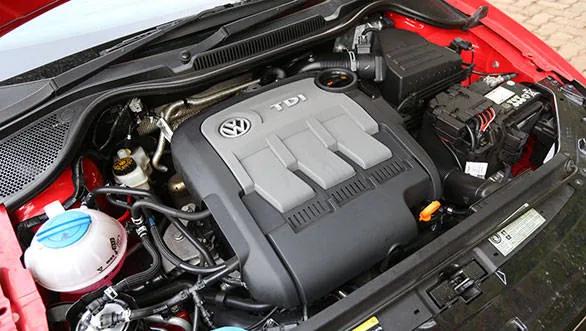
The valve cover is a recurring repair on both relevant 1.6 and 2.0 TDI applications. Shared replacement cover families exist: 03L103469R is listed for CLNA and CLLA among other engines. That supports the shared parts point, while the exact application and any superseded number should still be checked.3
Our experience with aged covers is that removing and resealing them can lead to repeat leaks. Replacing the gasket again may not produce a lasting result when the cover, sealing surface or fastening points are no longer sound. We generally favour replacing the complete aged cover in those cases, with the correct seals and fitting procedure. Plastic cover installation and its tightening sequence matter.4
This is a repair that costs more in parts at the first attempt but can avoid repeated labour and cleaning. Inspect the cover and crankcase ventilation condition instead of assuming that another gasket or more sealant will solve every leak. A gasket should not become a workshop subscription.
Technical references
Factory information and supplier technical guidance supporting this guide. The Code6 workshop cases, physical fin count, installation examples and sourcing budget are our own observations. Match every part and procedure to the actual vehicle.
- Volkswagen
- Skoda
- 2.0 TDI
- EA189
- DSG
- DQ250